
Buying a Race-Modified Jet Ski: Documents and Inspection
Looking at buying a race modified jet ski? Learn how to verify titles, check build records, inspect engines, and test performance before completing your purchase.
Buying a Race Modified Jet Ski: Essential Documents and Inspection Checklist
Purchasing a competition-ready personal watercraft offers instant access to blistering acceleration, sharp handling, and high-performance engineering. However, buying a race modified jet ski requires a far more meticulous approach than picking up a standard recreational craft from a showroom floor. Modified engines, custom tunes, and aftermarket handling components introduce distinct mechanical variables that can turn an exciting purchase into an expensive nightmare if you overlook critical flaws. Whether you are scouring listings across the country or local waterways, knowing what to review before handing over your hard-earned money will protect your investment.
In this guide, we break down everything you must evaluate when entering the competitive watercraft market in 2026. You will learn which paperwork guarantees lawful ownership, how to verify tuning credentials, and what physical inspection steps prevent mechanical disaster on your maiden voyage.
Understanding the Realities of Race-Built Personal Watercraft
A race craft is engineered to extract peak performance from every cubic centimeter of displacement. While a bone-stock runabout prioritizes reliability, fuel economy, and relaxed cruising, a race-tuned vessel operates on tight tolerances and aggressive parameters. Builders often raise boost levels, advance ignition timing, and reconfigure cooling pathways to keep engine bay temperatures manageable during extended high-speed runs.
Stock Reliability Versus Aftermarket Performance
When an enthusiast builds a competition machine, standard components frequently give way to high-flow fuel injectors, forged internals, titanium valve retainers, and modified superchargers. While these upgrades unlock incredible speed, they also accelerate wear on bearings, driveshafts, and pump assemblies. Before you browse jet skis for sale, determine whether you are prepared for the higher maintenance schedule, specialized fluids, and frequent rebuild intervals that these machines demand.
Understanding build specs is especially important when evaluating popular platforms like Sea-Doo personal watercraft or Yamaha supercharged models. If you want to compare baseline specifications before looking at modified units, check out our complete jet ski model directory to understand factory baselines versus custom modifications.
Critical Paperwork When Buying a Race Modified Jet Ski
Never let the thrill of raw horsepower distract you from legal due diligence. The process of buying a race modified jet ski begins with verifying ownership documents, part authenticity, and financial encumbrances. Incomplete paperwork is one of the most common reasons buyers find themselves with uninsurable or impounded watercraft.
Titles, Hull Identification Numbers, and Registrations
Every legitimate transaction requires an unencumbered title matching the Hull Identification Number stamped into the starboard side of the transom. Race hulls often see heavy impacts, repainting, or aftermarket carbon fiber reinforcement that can obscure or alter the factory stamping. If the hull stamp does not match the paperwork exactly, walk away immediately. Verify that there are no active liens against the vessel by contacting state registration authorities, particularly when browsing regional classifieds like jet skis for sale in California or jet skis for sale in New York.
Build Sheets, Invoices, and Engine Management Records
A reputable seller should present a documented history of every component installed on the craft. Ask for receipts from reputable performance shops, dynamometer tuning sheets, and invoices for forged engine internals. If the seller claims the machine features a brand-new top end, request photographic proof or the mechanic receipt confirming the rebuild date. You also need records of the Engine Control Unit flash, including fuel requirements, because racing tunes frequently require hundred-octane race fuel rather than standard pump gasoline.
Financing modified watercraft also presents distinct challenges, as conventional lenders base loan values on factory book prices rather than aftermarket additions. Prospective owners can run baseline numbers through our jet ski financing calculator to gauge estimated monthly payments before negotiating the cash premium that custom modifications typically demand.
Mechanical and Structural Inspection Checklist
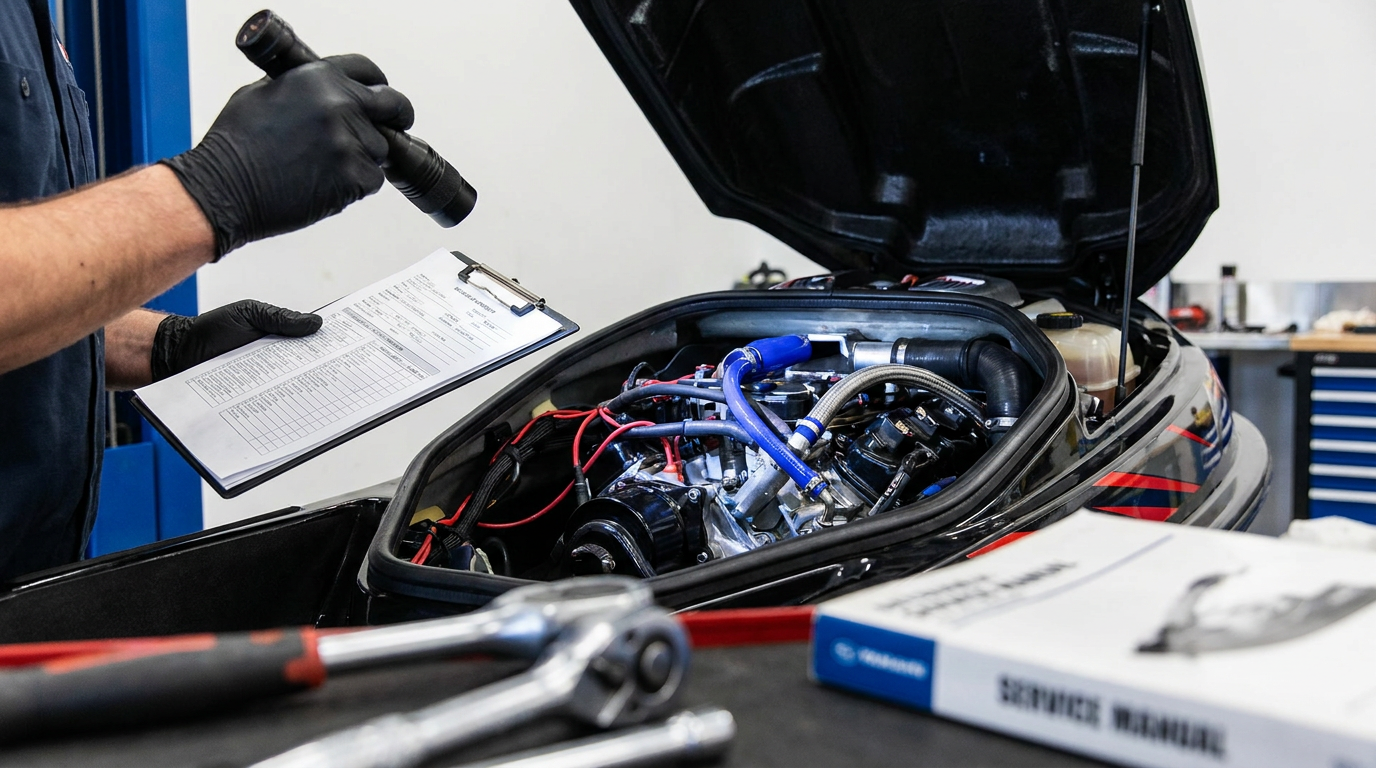
Once the paperwork clears your initial review, you must conduct a thorough physical inspection. Avoid looking at modified watercraft while wet or in poor lighting, as water droplets easily conceal hairline hull stress cracks and oil leaks. Bring a flashlight, a basic socket set, and a reliable compression tester.
Engine Bay and Supercharger Inspection
Open the seat and engine access hatches to inspect the compartment for cleanliness and signs of thermal stress. Look for scorched wiring harnesses, corroded grounding straps, and oil pooled beneath the engine block. Performance builds push extreme coolant pressures, so inspect every silicone hose for bulges, cracks, or loose T-bolt clamps.
- Compression and Leakdown: Run a compression test across all cylinders with the engine cold and throttles wide open, looking for values within five percent of each other across all cylinders.
- Supercharger Clutch Slip: If the craft uses a supercharger, check the clutch slip torque using a calibrated inch-pound torque wrench to ensure the unit is operating within proper specifications.
- Fuel Delivery and Lines: Inspect high-flow fuel rails, braided lines, and secondary pressure regulators for dried fuel residue, fraying, or ozone degradation.
- Exhaust and Waterboxes: Look for cracked free-flow exhaust pipes or delaminating silicone couplers that could allow toxic carbon monoxide and water into the engine bay.
If you are shopping among high-speed coastal craft such as jet skis for sale in North Carolina or coastal setups like jet skis for sale in Georgia, examine all aluminum fasteners closely. Salt exposure combined with modified engine bay heat cycles accelerates galvanic corrosion at an alarming pace.
Pump, Driveline, and Hull Dynamics
The jet pump transforms engine power into usable thrust, and modified craft put massive strain on these components. Inspect the wear ring for deep scoring, and measure the clearance between the impeller blades and the wear ring housing with a feeler gauge. Clearance should generally stay under factory thresholds to prevent cavitation during hard holeshots. Examine the leading and trailing edges of the stainless steel impeller for stone nicks, bending, or thinning. Look beneath the stern at the intake grate, ride plate, and trim tabs to confirm that all aftermarket hardware remains securely torqued with marine-grade fasteners.
On-Water Testing and Verification
Never conclude buying a race modified jet ski without an extensive on-water test ride. A high-strung racing engine may start instantly on a garden hose with zero load, yet sputter and stumble the moment backpressure builds in the water. Start the engine while floating, let it reach operating temperature, and confirm that cooling water exits the bypass fittings steadily.
Once clear of launch ramps, test throttle response throughout the entire rev range. The machine should accelerate smoothly from idle to maximum RPM without hesitation, surging, or anomalous vibrations. Monitor the digital gauge cluster for abnormal water temperature readings, oil pressure warnings, or check engine codes. After riding aggressively for ten minutes, beach the craft, open the hood, and inspect the bilge for water intrusion, fuel vapors, or escaping exhaust fumes.
Conclusion and Final Ownership Steps
Succeeding at buying a race modified jet ski comes down to disciplined skepticism and thorough verification. By confirming valid title documentation, scrutinizing dyno sheets, executing compression checks, and demanding an on-water demonstration, you can acquire an exhilarating machine with total confidence. Treat high-performance craft with the respect their engineering requires, and you will enjoy seasons of unmatched speed and adrenaline.
Frequently Asked Questions
Can I run pump gas in a race modified jet ski?
It depends entirely on the specific ECU tune, compression ratio, and supercharger pulley size installed on the craft. Mild recreational modifications often run safely on 91 or 93 octane pump fuel. High-compression racing builds frequently require specialized race fuels or ethanol blends like E85 to prevent catastrophic detonation.
Is buying a race modified jet ski legal for recreational lake use?
Yes, provided the vessel retains required US Coast Guard safety equipment and complies with local sound ordinances. Many aftermarket free-flow exhausts exceed legal decibel limits on public lakes, so confirm that your craft meets local acoustic standards before riding.
Why is insurance higher on modified watercraft?
Insurance carriers view modified personal watercraft as elevated risks due to higher top speeds, expensive replacement parts, and competition use. Some standard marine insurers exclude modified hulls completely, requiring specialized agreed-value policies through specialty underwriters.
Should I hire a professional mechanic for pre-purchase inspection?
Yes, hiring a certified marine mechanic who specializes in performance tuning is one of the smartest investments you can make. A qualified technician possesses diagnostic software capable of reading ECU operating hours, RPM history logs, and historical fault codes.
Ready to buy or sell? Explore the jet ski marketplace, jet ski valuation calculator, or sell your jet ski at Jet Sports Trader.
Related Articles

Jet Ski Shipping and Delivery: Costs and How Long-Distance Buys Work
Considering a long-distance PWC purchase? Our guide breaks down jet ski shipping costs, logistics, and how to safely transport your new watercraft.

Jet Ski Dealer vs Private Seller: Where to Buy Your Next PWC
Deciding between a jet ski dealer vs private seller? This guide breaks down the pros and cons of each, covering price, warranty, financing, and inspections to help you make the best choice.

Jet Ski Insurance Claims: What's Covered and How to File
Filing a jet ski insurance claim can be stressful. Our expert guide covers what your PWC policy protects, how to file, and what to do if your watercraft is a total loss.
Ready to Find Your Perfect Jet Ski?
Browse thousands of listings from trusted dealers nationwide